
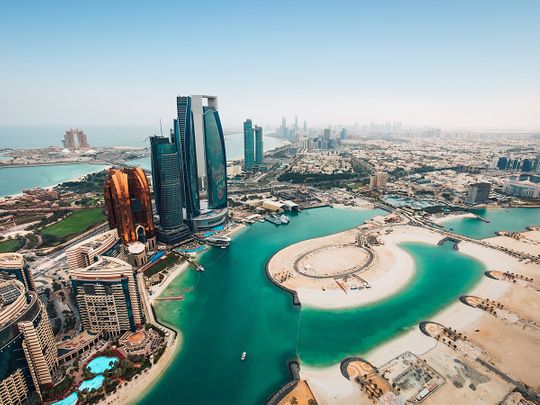
When most entrepreneurs or businesses are considering setting up a business in the UAE, Dubai tends to be the emirate that steals the limelight. Thanks to its profile as an attractive investment location, its already well diversified economy and the vast amount of information available online, it attracts all the attention, often relegating the country’s capital, Abu Dhabi to an afterthought, or worse still, being dismissed entirely. That’s a shame, because Abu Dhabi holds just as much promise for investors and is definitely worthy of consideration if you want to establish a business presence and strong client base in the Emirates.
As the capital of the country and home to 96% of the UAE’s vast oil reserves, Abu Dhabi’s economy has traditionally been sustained by revenues from its hydrocarbon industry. However, this is beginning to change. Diversification initiatives, public-private partnerships, and strategic investments in knowledge-based sectors have made a huge impact, helping the emirate to grow the contribution of its non-oil sectors to an all-time high of 52.8% and opening up lucrative opportunities for private sector participation.
In stark contrast to the saturated and highly competitive business environment in neighboring Dubai, Abu Dhabi presents a less crowded arena for business growth, but one that is certainly no less supportive than its more illustrious neighbour.
Abu Dhabi’s commercial landscape
While in Dubai, the private sector has dominated the business landscape for some time, Abu Dhabi has exercised a much more cautious and calculated approach, being selective in how it expands.
Currently, more than half of the inward FDI to Abu Dhabi is in either real estate or natural resources, but this is now beginning to shift as the government begins to look to the future and develop industries such as ICT, AgTech, financial services, healthcare and biopharma.
These knowledge-based sectors are the cornerstone of Abu Dhabi’s Vision 2030 and are seen as the key to ensuring a secure and sustainable future.
Abu Dhabi Investment Office’s (ADIO) Innovation Programme is a case in point. Since its launch in June 2019, it’s provided financial incentives of around AED 2 billion to support companies that can deliver transformative solutions in these areas. A notable example is G42 Group, a tech and AI company which partnered with ADIO on a joint venture called “G42 Healthcare” which leverages advanced technologies such as genomics, artificial intelligence, and data analytics to enhance healthcare services and research.
This is just one of many examples that demonstrates Abu Dhabi’s forward-thinking approach and willingness to back projects that align with its goals.
ADIO assistance
Other significant examples of ADIO’s support of foreign investment can be seen in initiatives and programmes like Hub71 and ADIO Ventures.
Hub71, a major tech hub and accelerator programme in the emirate, focuses on helping tech startups get a foothold in the UAE and giving them all the tools needed to ensure their success. Aside from access to funding, office space, healthcare and even subsidised housing, perhaps more importantly, Hub71 connects businesses with established industry players, corporate giants and other government entities that can provide mentorship, strategic partnerships, and invaluable expertise.
This level of support is uncommon in the corporate world yet is an area where both Abu Dhabi and indeed the wider UAE shine: That if you’ve got a great business idea, they’ll ensure that it has every chance to succeed and realise its potential.
Public-Private Partnership (PPP) Projects
The presence of government support in Abu Dhabi is also a big draw. In 2019, a new law regulating PPPs (Law No.2) was brought in to encourage private sector involvement in major infrastructure projects in the emirate. These included education, transport and other municipal works, with AED 10 billion set aside to facilitate it. Three recent projects included the development of student living accommodation at Khalifa University, the installation of power saving, LED street lighting, and the construction and maintenance of three schools across Zayed City.
This allowance of private sector involvement in government projects is a win-win for both parties.
Sharing the risks associated with large-scale projects between the government and the private sector reduces the financial burden on private companies, making it easier for them to participate in projects that might otherwise be out of reach. For the government, it’s a way to manage public funds more efficiently and accelerate progress in public services.
These partnerships are a great way to access the UAE market without the complexities of starting from scratch. They often involve long-term contracts, which ensures a steady revenue stream. They also tend to lead to long-term partnerships which can open doors to future projects and collaborations.
Ghadan 21
The ability to look to the future and anticipate economic shifts typifies Abu Dhabi’s approach to development. From the establishment of The Mohamed bin Zayed University of Artificial Intelligence, the world’s first AI university, to the launch of the Masdar City project, a pioneering eco-friendly urban development.
Ghadan 21 is another prime example. In conjunction with ADGM and Hub71, its AED 50 billion, three-year stimulus programme has succeeded in attracting 102 startups to Abu Dhabi. It’s also helped the Abu Dhabi government weather a series of external shocks, such as geopolitical tensions, the global pandemic, and a prolonged drop in oil prices that began in mid-2014.
It offers a range of financial incentives to businesses, including subsidies, grants, and reduced fees. For example, it includes initiatives like “Ghadan Ventures,” which provides financial support to startups and tech companies, and “Ghadan Markets,” offering subsidies to attract leading retailers.
In addition, under the Ghadan 21 program, the Abu Dhabi government has embarked on a comprehensive mission to streamline regulations and introduce investor-friendly policies. These efforts are geared towards reducing bureaucracy and making it significantly easier for companies, both domestic and foreign, to set up and operate in Abu Dhabi. The changes in licensing procedures, for instance, simplify the process for obtaining necessary permits and approvals, thus expediting the establishment of businesses. Furthermore, liberalised foreign ownership rules have allowed for full ownership in several key sectors, including technology, manufacturing, and renewable energy, fostering an environment of increased investment and competition. Additionally, innovative visa policies, like the Golden Visa, offer long-term residency options to foreign investors, enhancing the stability and attractiveness of the emirate for businesses seeking growth and opportunity.
A comprehensive package
Abu Dhabi, often overlooked in favor of its more renowned counterpart Dubai, is rapidly emerging as a compelling hub for foreign investors. The emirate’s transformation is driven by diversification, innovative sectors, and visionary initiatives such as Ghadan 21. Unlike its bustling neighbour, Abu Dhabi offers a less crowded yet equally supportive landscape for business growth.
What sets Abu Dhabi apart is its substantial government backing, fostering public-private partnerships, and pioneering tech hubs like Hub71. ADIO Ventures further exemplifies its commitment to nurturing entrepreneurship. In addition, streamlined regulations, progressive foreign ownership rules, and flexible visa policies make establishing and running businesses a breeze.
This comprehensive package underscores Abu Dhabi’s rising prominence as a premier choice for foreign investors, packed with opportunities for success and collaboration. For those seeking growth and opportunity in the Emirates, Abu Dhabi deserves a closer look.